Abnormalities Versus Failures
Learn more about the difference between abnormalities and functional failures. Understanding this difference can help to prevent further issues before they arise.
What better way to spend an afternoon than to debate which came first, the chicken or the egg? One thing that cannot be debated, however, is the fact that abnormalities come before failures. This is a fact.
We are conditioned early on to react to failures, the loss of function, why did the lights go out? Why did my car stop working? The abnormalities that lead to these failures often fly below our radar. This ability to change our thinking or refine our attention to look for abnormalities is the first critical step in transforming from a reactive to a proactive organization. Reactive organizations attribute their performance to bad luck, proactive organizations make their own luck.

So, what is the difference between an abnormality and a failure? First, I prefer to use the phrase “functional failure” rather than simply “failure.” I must concentrate and force myself to use these words, but it has an important effect on my thinking and the thinking of those around me. To me, failure seems to be an arbitrary word open to interpretation. On the other hand, loss of function or functional failureThe state in which a physical asset or system is unable to perform a specific function to a level of performance that is acceptable to its owner or user. is quite clear; I can no longer do what I desire.
If the lightbulb goes out, I can no longer read my book – loss of function. If the impeller wears on my pump and can no longer produce my product in the required quantity – loss of function. If my tire goes flat and I can no longer drive my car at full speed – loss of function. In each case, if we start with that condition we desire, the loss of this ability or function becomes quite clear.
Abnormalities, on the other hand, are the clues that our assets provide to us that something is wrong and that we are on that pathway to losing our desired function. They are like a baby crying. Something is wrong, and as caretakers of our assets (our babies), it is our job to do something about it; proactively before functional failure occurs.
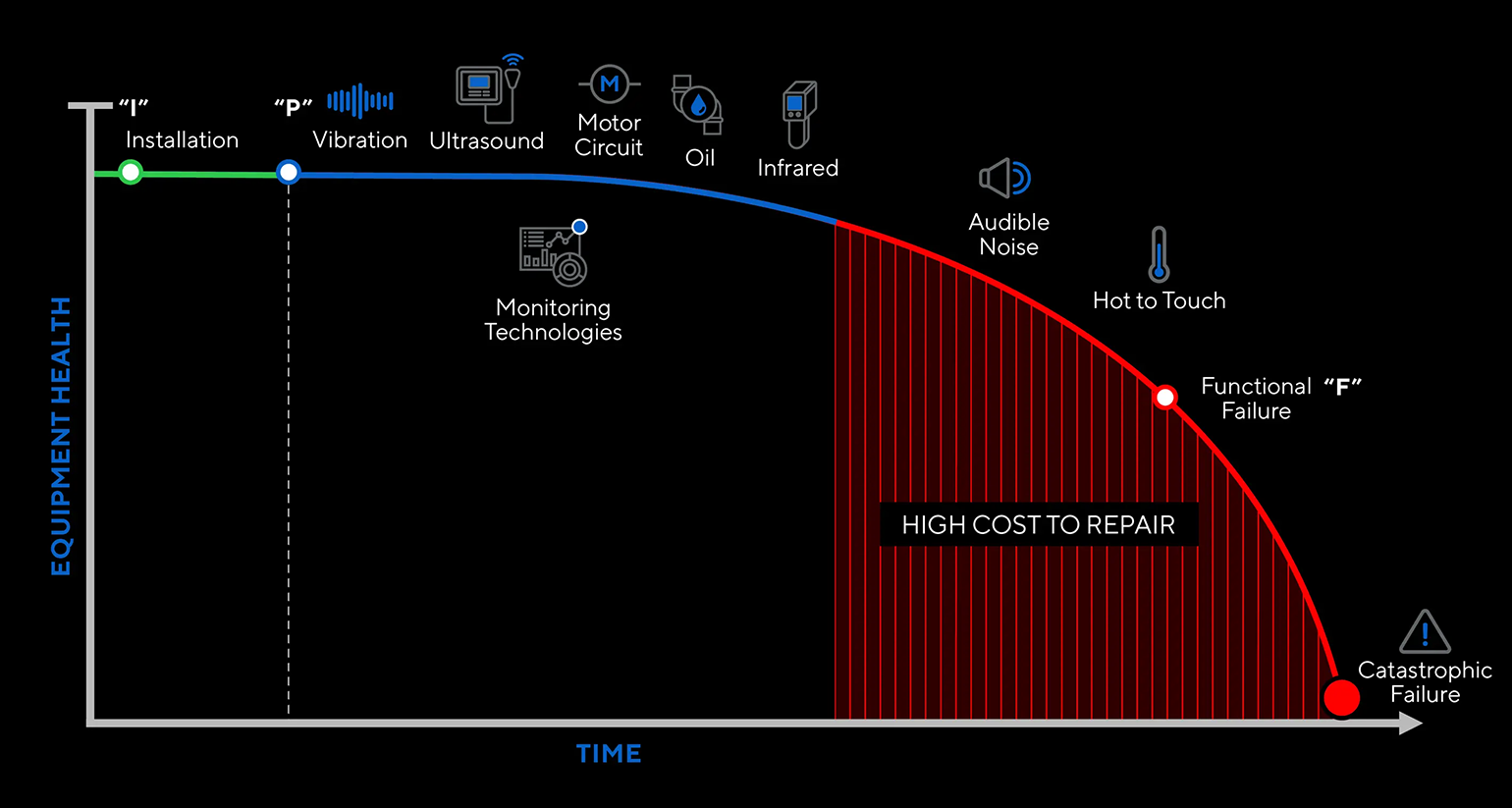
This pathway to functional failure and the abnormalities that mark this path are best described by the P-F curvePotential to Failure Curve shown below. Its explanation is quite simple and powerful at the same time. Let’s take a look:
- The vertical axis represents our equipment condition, while the horizontal axis represents time.
- The higher the equipment condition, the better.
- The first point on the graph (upper left-hand corner) is “the point where the failure starts to occur.” Let’s consider this point P. Imagine that we forget to lubricate the bearings on an electric motor. Eventually, all the grease will evaporate out, leaving metal-to-metal contact. This is point P in this example.
- The equipment (asset) starts to degrade, losing its condition slowly at first but then increasing in speed as time continues. As this process continues, the equipment provides clues that inform us of what is happening – at first, very subtle clues but increasing in magnitude (and our urgency, I hope) as the process continues. These clues are the abnormalities.
- If we do not act proactively to the abnormalities, we will reach the point labeled “catastrophic failure.” This is point F, or the point of functional failure.
- Because we have failed to react proactively to the abnormalities, we will now have to react to the functional failure – the choice has been made for us!
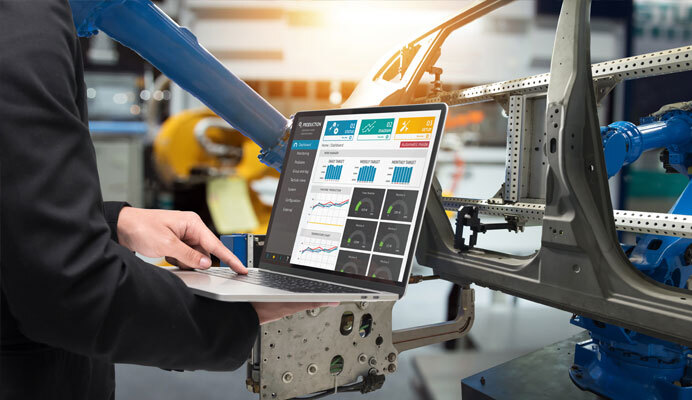
What should we do about abnormalities? We must report them in an official way as soon as we see them. When I say “reporting in an official way”, I mean something like putting a work request into our computerized maintenance management systemComputerized systems that schedule, track and monitor maintenance activities and provide cost, component item, tooling, personnel and other reporting data and history. (CMMSComputerized Maintenance Management System) or using an abnormality tag that is part of our operator careSpecific, detailed activities accomplished by operators to ensure proper asset operation, routinely check asset operating parameters (pressure, temperature, speed, etc), make necessary adjustments, lubricate, and make minor repairs incidental to the production process, and provide early detection of potential problems requiring maintenance support. process.
Tugs on the shirtsleeve, emails, phone calls, sticky notes, none of these count. This collection of official notifications represents what we know to be our backlog, and a full and rich backlog is critical to our proactive approach to maintenance.
I talk to many people who tell me, “I only want people to report the important or critical problems”. Guess what? Today’s unimportant problem will quickly become tomorrow’s important one. The P-F curve illustrates this perfectly.

Better to have a solid reporting system, a simple method to prioritize work so we are attacking the most important abnormalities first, as well as a robust and visual means to communicate our progress to everyone who participates in the process (managers, technicians, operations, and maintenance).
If we do not report abnormalities early or strive to report only those ambiguous “really important ones,” we sell ourselves short. When we fail to report abnormalities early, we lose the ability to address them early.
The most important thing to remember is this: all abnormalities eventually become functional failures. It is our choice to address them on our terms (proactively) or when the equipment demands it (reactively).
About the Author
Mike Gehloff
Mike Gehloff has worked in the maintenance and reliability discipline for over 30 years with a wide range of experience both as a practitioner and a consultant. His area of expertise lies within the social sciences related to the discipline, particularly in the work control (maintenance planningDetermination of resources needed and the development of anticipated actions necessary to perform a scheduled major job. An orderly appraisal and guarantee of all the prerequisites necessary to ensure completion of a given job at a predetermined time. It covers availability of ordered equipment, stores, materials, production, shutdowns, sketches, prints, specifications, etc. and scheduling), operator care, and management systems areas.
Mike has worked extensively in the steel industry and held several corporate and division-level reliability positions. He also has experience in the mining, food and beverage, oil and gas, and power generation industries with a proven track record of delivering results. Mike is particularly effective in team-based environments where frontline associates are empowered to make a change in their organization. Breaking down barriers to communication, motivation, and a set of common goals for the organization are all areas that represent a professional passion for Mike.
Mike graduated from Eckerd College. He is a Certified Maintenance and Reliability Professional (CMRP), as well as a Certified Plant Maintenance Manager (CPMM). Mike is also a Six SigmaSix Sigma is a process improvement strategy, originally developed by Motorola, that’s designed to remove the causes of defects and errors in manufacturing and business processes using a statistical methodology called DMAIC (Design, Measure, Analyze, Improve, Control). Six Sigma creates a special infrastructure of people within the organization (“Black Belts”) who are experts in the facilitation of the DMAIC process. Black Belt and has earned a Master of Business Administration from the University of Florida. Mike is always open to adventure and has an extensive international travel resume.
Connect with Mike on LinkedIn.