Shutdown, Turnaround, Outage (STO)
Improve the planning, control, execution, and review of industrial shutdowns, turnarounds, and outages. This three-day course helps maintenance and operations leaders manage scope, schedule, risk, communication, and performance during major planned events.

COURSE DURATION
Three days
DELIVERY OPTIONS
Public or private training
CONTINUING EDUCATION CREDITS
RMIC credit eligible | 24 credit hours

COURSE OVERVIEW
Manage STO Events with a Defined Framework and Measurable Controls
Shutdowns, turnarounds, and outages are necessary disruptions that can create significant production, cost, safety, and schedule exposure when planning and control are weak. This course provides practical methods for building and improving an STO management framework.
Exercises and simulation help participants practice outage preparation and execution in the classroom. The course concludes with a visioning exercise to design a new framework or identify improvements to an existing process.
WHO SHOULD ATTEND
Who This Course is For
This course is designed for professionals responsible for planning, coordinating, managing, or executing industrial shutdowns, turnarounds, and outages (STOs), including:

Maintenance and operations superintendents responsible for aligning outage work with production priorities, resource availability, safety requirements, and overall site performance.
Maintenance managers looking to improve outage preparation, work execution, contractor coordination, schedule performance, and the transition back to normal operations.
Shutdown and turnaround managers responsible for developing and managing STO plans, coordinating cross-functional teams, controlling scope, and keeping work aligned with schedule, cost, and operational objectives.
Maintenance planners and schedulers seeking practical methods for defining work scope, developing job plans, sequencing activities, coordinating resources, and building more executable outage schedules.
Reliability engineers and reliability leaders working to ensure outage scope addresses critical equipment risks, recurring failures, inspection findings, and asset reliability priorities.
Operations leaders and supervisors involved in equipment preparation, shutdown coordination, permitting, handoffs, startup, and communication between operations and maintenance teams.
Project engineers and technical specialists supporting capital work, inspections, repairs, modifications, or other technical activities that must be integrated into the outage plan.
Other STO team members and stakeholders who need a stronger understanding of how effective planning, coordination, execution, and closeout contribute to safer, more predictable industrial outages.
WHAT YOU WILL LEARN
Practical Skills and Knowledge You Can Apply
Participants will build the knowledge and analytical capability to:
Design a fundamental framework for managing the STO process.
Analyze and critique the organization’s current STO process.
Develop a communication plan for an upcoming STO event.
Calculate and use the critical path to support management decisions.
Identify critical risks and define appropriate mitigation actions.
Control scope creep and support scope freeze.
Optimize task and overall STO duration using schedule and visual management methods.
Establish metrics, post-outage reviews, and improvement plans for future events.
COURSE CONTENT
Curriculum Organized for Progressive Learning
The course progresses from STO framework development and planning fundamentals through scope, risk, scheduling, execution control, performance measurement, and continuous improvement.
STO Framework and Governance
- Fundamental outage framework
- Current-process assessment
- Roles, governance, and decision points
Communication, Scope, and Risk
- Communication planning
- Critical risk factors and mitigation
- Scope creep control and scope freeze
Schedule and Execution Control
- Critical path calculation
- Task-duration optimization
- Gantt chart tracking and reporting
- Visual management techniques
Measurement and Improvement
- STO performance metrics
- Post-outage review report
- Corresponding improvement plan
- Future-state improvement roadmap
Classroom Application
- Exercises and simulation
- Framework visioning and design
UPCOMING COURSES
Find a Public Session
View available dates and locations for upcoming public sessions. When no public workshop is scheduled, contact Allied Reliability about private training for your team.
September 15-17, 2026 | Charleston, SC
View Course & Register
July 20-22, 2027 | Houston, TX
View Course & Register
our approach
Training Designed for Practical Workplace Application
Allied Reliability training helps industrial teams build capabilities they can apply to equipment, work processes, and reliability improvement priorities.
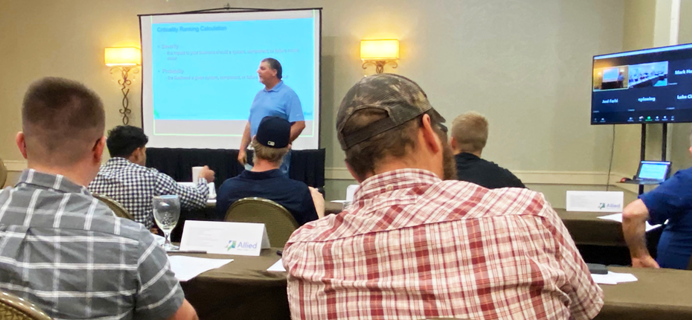
Application-Based Instruction
Courses connect technical concepts to equipment, operating conditions, and decisions participants encounter in industrial facilities.
Experienced Industry Instructors
Instruction is led by professionals with practical maintenance, reliability, engineering, and operational experience.
Operational Alignment
Course content is structured to help participants apply learning to reliability, asset performance, safety, productivity, and maintenance priorities.
Flexible Delivery
Public courses support individual development, while private training can be coordinated for teams and organizational needs.
FAQs
Common Questions About This Course
Who should attend this course?
The course is designed for the roles listed in Course Details. It may also be useful for adjacent technical, operational, or leadership roles that influence the covered work.
Is the course available privately?
Yes. Allied Reliability offers the course in public and private settings. Private delivery can support team development and organization-specific scheduling needs.
How can I build a business case for this reliability training course?
To gain management approval, connect the training investment to a specific business need—such as reducing equipment failures, improving maintenance execution, closing critical skills gaps, or supporting reliability goals. Request our Training Business Case Template to organize the rationale, expected outcomes, costs, and value of the course for your management team.
How long is the course?
The course duration is three days.
Where are public courses held?
Locations and delivery formats vary by scheduled session. Review the current course listing or contact the training team for availability.